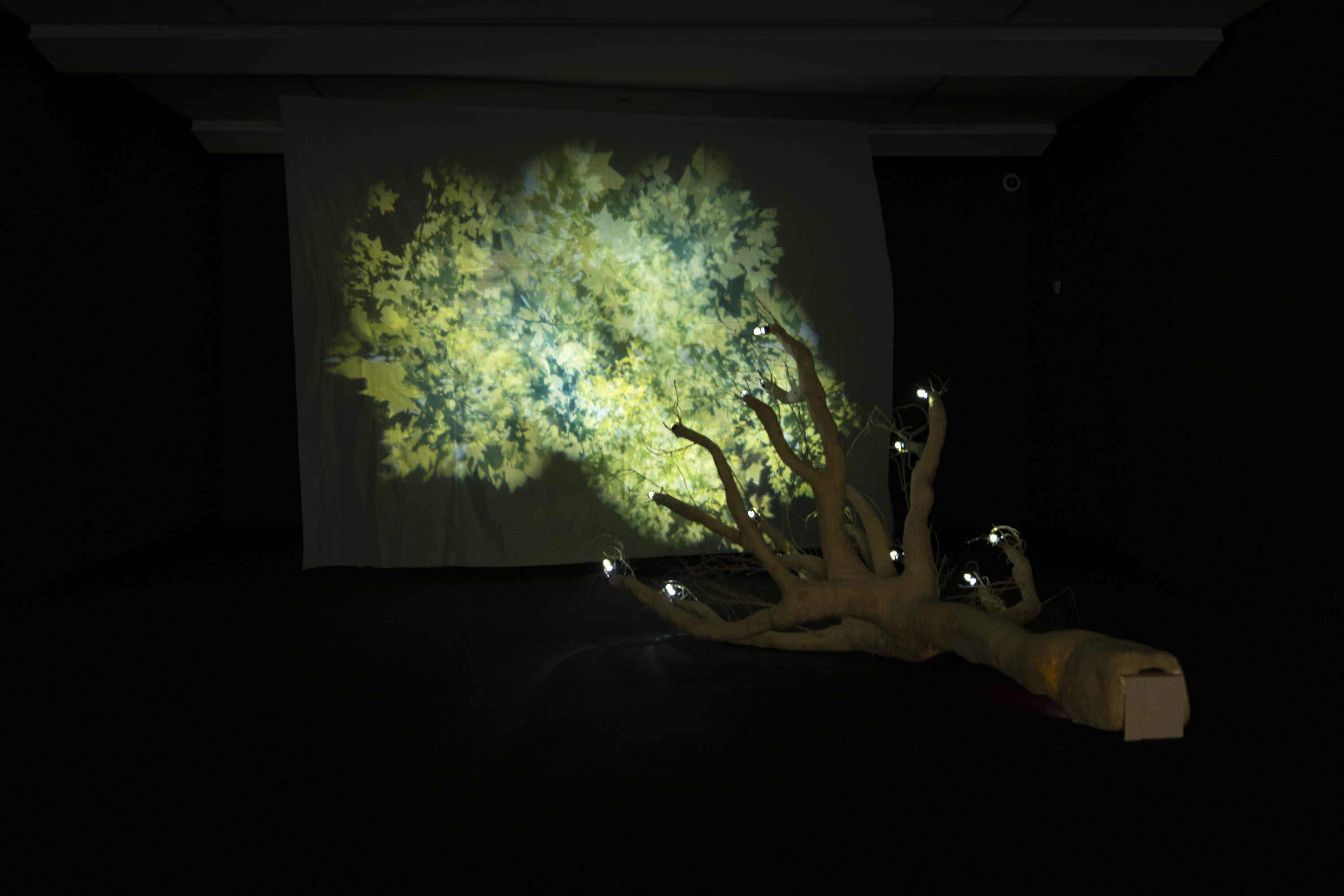
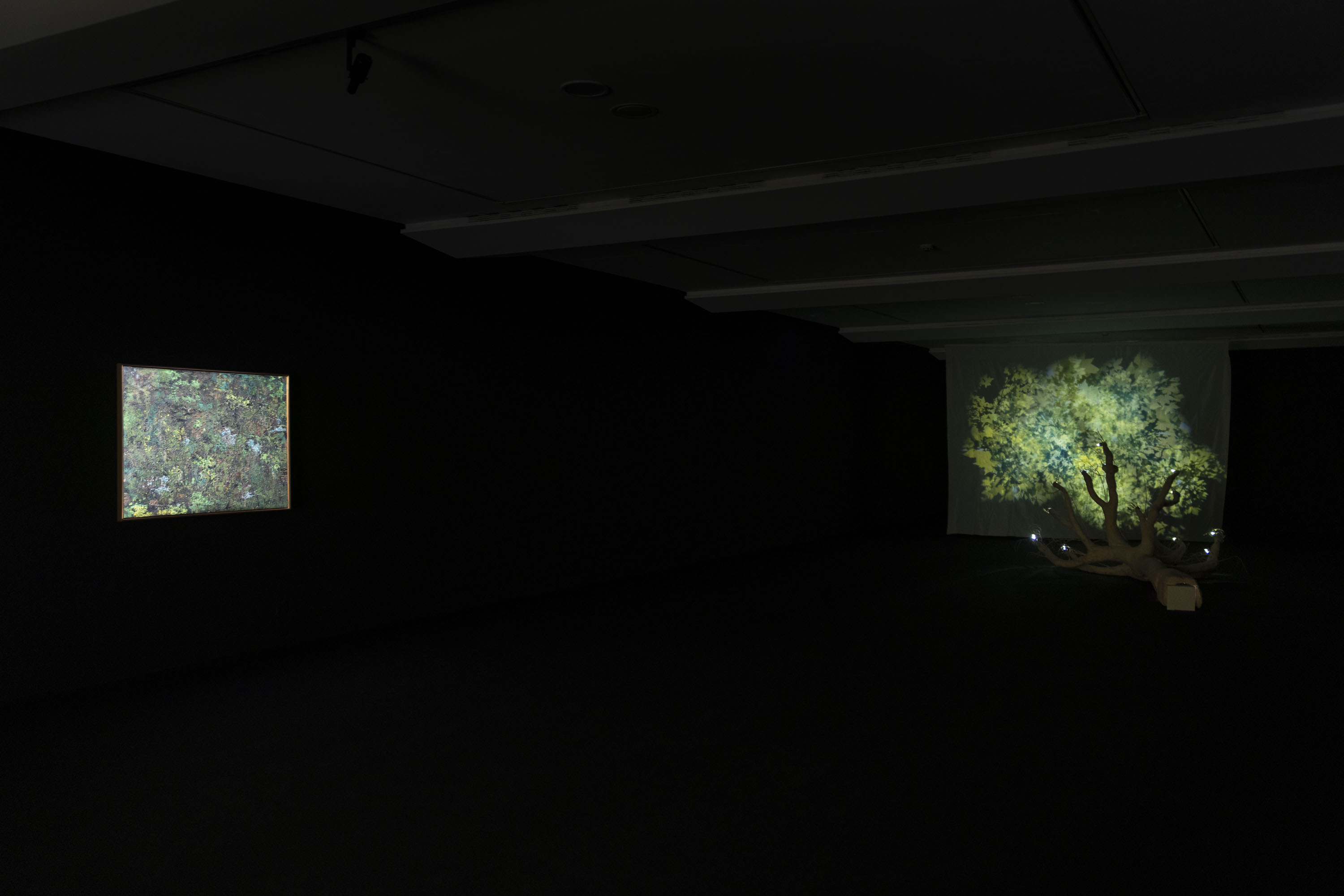
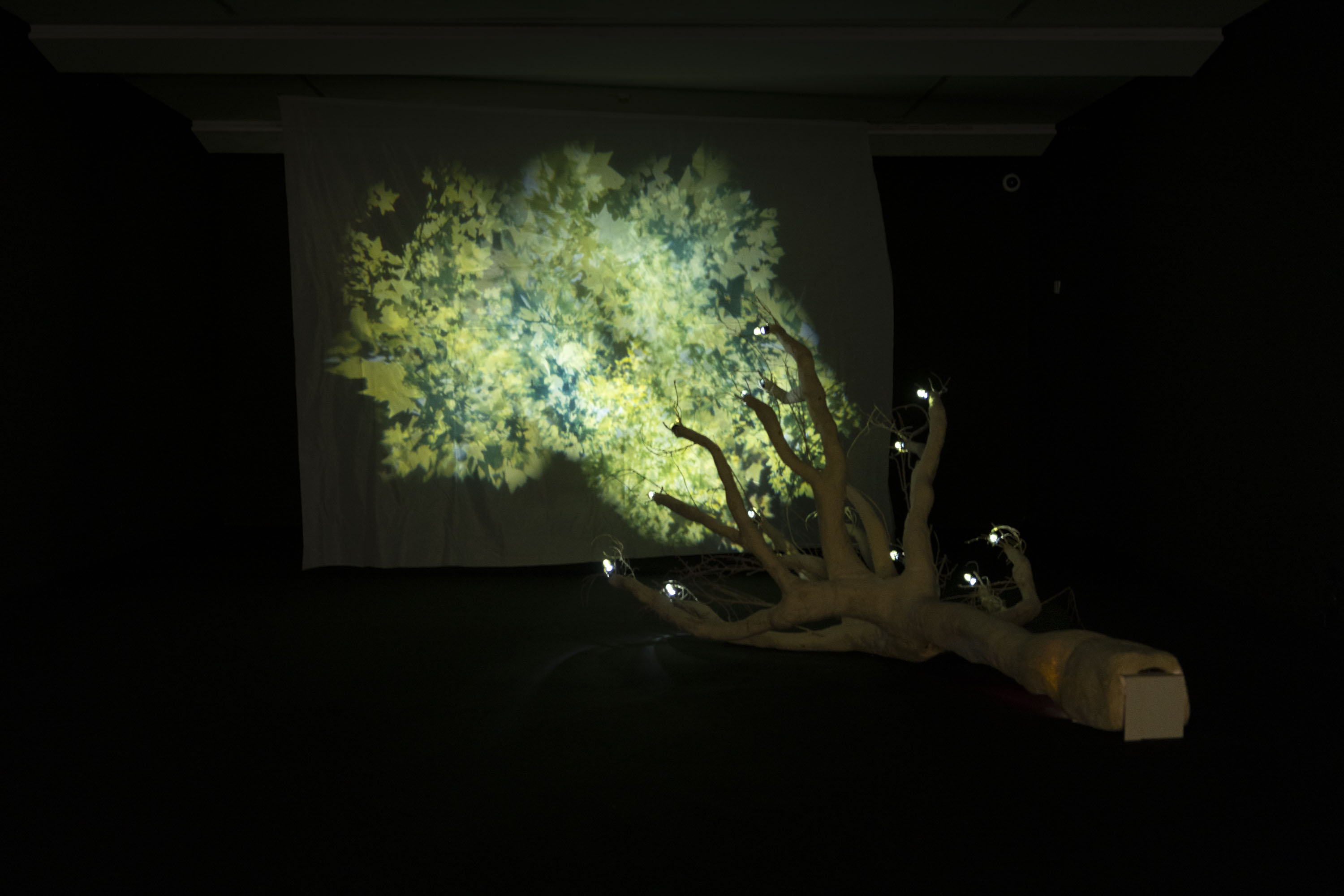
En esta nueva entrega apelamos a lo escénico de un modo similar a lo proyectado en el año 2025, un espacio en penumbra que, si entonces acogía una lectura de carácter político con las obras de Fernando Sánchez Castillo, Alberto Sánchez y José Caballero, ahora lo hace desde una interpretación de la naturaleza, que es uno de los asuntos que van a vertebrar el programa de 2026. Puede verse en nuestro espacio la relación entre dos figuras centrales del arte realizado en nuestro país en muy diferentes momentos, Gustavo Torner y Daniel Canogar. El primero realizó en 1957 una pintura de gran impronta matérica titulada “Galicia”. Integrante, junto a Zobel y Rueda, del Grupo de Cuenca, Torner falleció hace muy poco, en verano de 2025 a los 90 años, dejando tras de sí un extenso y muy personal legado. Sirva esta presentación para rendir homenaje a su figura. Junto a él, una obra de Daniel Canogar titulada “Photosynthetic Remembrance” se sitúa en sentir diferente, pues se trata de una compleja instalación de grandes dimensiones que resumen el interés del artista por las posibilidades de la tecnología, un ámbito del que es pionero en España. Realizada en 2005, es considerada una de las obras más relevantes de un artista que mantiene una frenética actividad.
Hay analogías claras entre los dos trabajos, pero también diferencias notables. La obra de Torner es típicamente informalista, radicalmente abstracta. Su formato es medio, más bien discreto, pero es tal la fogosidad de lo que en su interior ocurre que desborda la contención que parecería definirlo. Torner no busca una representación de la naturaleza sino que trata de presentar su dimensión tangible y física. De esa época es conocida una inclinación hacia una materialidad que resulta de la traslación de lo natural a la superficie del cuadro, más síntesis formal que imagen. Desde esta perspectiva, la obra de Daniel Canogar quedaría en las antípodas por muchas razones, aunque la apariencia pueda ser afín. El componente instalativo es incuestionable como lo es la destreza técnica que hace posible la pieza. Pero hay un componente de ficción que marca la distancia crucial entre los dos artistas, una suerte de juego, de truco, que convierte imágenes fijas en una seducción dinámica gracias al dispositivo al que acude Canogar. El día y la noche se dan cita en este abrazo de imágenes hermanas, lo natural visto desde lugares antagónicos.
In recent years, the way of presenting the permanent holdings of the Contemporary Art Collection Association has lain somewhere between the desire to come up with possible new narratives around the historiography of Spanish art and the desire to take advantage of the huge potential of the spaces in our building, whether its historical area or its extension rooms, more inclined towards the white cube but not thereby lacking a notable uniqueness. Narrative and scenography are, therefore, the two mainstays on which our work in this Collection is based. The title of the series – ‘A Scene’ – leaves no room for doubt.
In this new instalment we have appealed to the scenic in a similar way to what was projected in 2025, a space in semi-darkness which at that time hosted a reading of a political nature with the work of Fernando Sánchez Castillo, Alberto Sánchez and José Caballero, and now does so from the interpretation of nature, which is one of the topics that will make up the backbone of the programme for 2026. In our space we can see the relationship between two central figures of the art produced in our country at very different times – Gustavo Torner and Daniel Canogar. In 1957, the former produced a painting of great material imprint entitled ‘Galicia’. Torner was a member of the Cuenca Group, together with Zobel and Rueda. He died very recently, in the summer of 2025, at the age of 90, leaving behind him an extensive and highly personal legacy. This presentation therefore serves as a tribute to his figure. Next to him, a piece by Daniel Canogar entitled ‘Photosynthetic Remembrance’ is in a different vein, as it is a complex installation of large-scale pieces that draws on the artist’s interest in the possibilities of technology, a field in which he is a pioneer in Spain. Made in 2005, it is considered one of the most relevant pieces by an artist who maintains frenetic activity in his work.
There are clear analogies between the two works of art, but also notable differences. Torner’s work is typically informalist, radically abstract. Its format is medium, rather discreet, but such is the fieriness of what goes on inside it that it overflows the restraint that would seem to define it. Torner does not seek a depiction of nature but rather tries to present it in a tangible, physical dimension. From this period the inclination towards a materiality that results from the translation of the natural to the surface of the painting is well known, more of a formal synthesis than an image. From this perspective, Daniel Canogar’s work is the exact opposite for many reasons, even though the appearance may be similar. The installation component is unquestionable, as is the technical skill that makes the piece possible. And yet there is a fictional component that marks the crucial distance between the two artists, a sort of game or trick, that turns still images into a dynamic seduction thanks to the device Canogar uses. Day and night come together in this embrace of sister images, the natural seen from antagonistic points of view.